An Institutional Commitment · Open to All Institutions of Learning

The Humanitas AI Compact

Artificial Intelligence in the Service of Humanity

Artificial Intelligence Must Serve Humanity

For the first time in history, a papal encyclical has placed AI at the centre of the Church's social teaching and called institutions of learning to respond. This Compact is our response: seven principles, seven commitments, one shared direction.

Sign the Compact


The Compact


Across Africa, across the Global South, across every community that has received the costs of technological change before its benefits, the question of who artificial intelligence serves has never been more urgent. For the first time in history, a papal encyclical has placed AI at the centre of the Church's social teaching and called institutions of learning to respond. The poor, the sick, the migrants and the least among us will become, in the words of Pope Leo XIV, the cornerstone. Women are named here, Pope Leo XIV named them specifically, because their equal participation in learning and public life remains unrealised across much of the world.

The goods of the digital age, knowledge, data, algorithms, AI itself, belong to all of humanity and must serve all of humanity. This Compact is our response: seven principles, seven commitments, one shared direction. We invite every institution of learning, wherever it is on earth, to join this response.

We call upon educational institutions and other institutions entrusted with the human person across Africa and the world — all institutions entrusted with the formation, protection, education, healing, governance, and advancement of the human person — to sign and uphold this Compact.

Seven Principles


  1. Human Dignity

    Every person possesses an infinite dignity, inalienably grounded in their being, which prevails in and beyond every circumstance. No technology can give it. No technology can take it away.

  2. Solidarity

    We are responsible for one another. AI that excludes any human being violates the bond that holds humanity together.

  3. Subsidiarity

    Decisions about AI must be made closest to those affected. Schools, universities, communities and associations must contribute to the discernment of choices that affect people's daily lives.

  4. The Common Good

    The goal of all learning and technology is a world built not for the few but for the common good of all.

  5. The Universal Destination of Goods

    Algorithms, data, platforms and the benefits of AI belong to all of humanity. When these remain concentrated in the hands of a few, a new injustice is created that contradicts the first principle of the whole ethical and social order.

  6. Truth

    Truth is a common good and not the property of those with power or influence. The pursuit of truth is the defining purpose of all learning. AI must serve this pursuit, not replace it.

  7. The Integral Person

    Learning forms whole human beings. No person can be reduced to just a data point, a digital profile, or a measurable output. The quality of a civilisation is measured by the care it is able to offer.

Seven Commitments


  1. We commit to reviewing and renewing our programmes so that learning in the age of AI forms whole persons, capable of reflection, discernment and conscience.

  2. We commit to equipping our students, staff and those we serve with genuine digital literacy: the capacity to understand AI, its possibilities, its limits and its meaning for human dignity.

  3. We commit to directing our AI-related work toward those most at risk of exclusion, the poor, the sick, the displaced and, in particular, women and girls.

  4. We commit to guiding our AI-related work toward justice and peace, and to resisting the subordination of learning to purely economic or technical efficiency.

  5. We commit to forming a renewed educational alliance for the digital age, with families, communities, associations and institutions across the world, placing the human person and the common good at the centre of all we do.

  6. We commit to using our institutional voice in the governance of AI, contributing to the discernment of choices that affect people's daily lives: in public discourse, policy processes and ethical frameworks.

  7. We commit to the principle that the goods of the digital age belong to all of humanity and must not remain the privilege of the few. We will work, within our capacity, to advance this common good in everything we do.

The Seven Pillars

Humanitas AI Education


Humanitas AI Education is a new framework for education in the age of artificial intelligence, grounded in practical service delivery, integral education and human dignity.

  1. A Return to First Principles

    Before skill comes conscience. Before conscience comes formation.
    Competence without conscience is the most dangerous product of any education system. Humanitas AI Education begins with moral formation grounded in Catholic Social Teaching — from Augustine of Hippo through Rerum Novarum, Populorum Progressio, and Magnifica Humanitas. As AI mimics moral reasoning without possessing it, the formation of genuine conscience becomes not less important but more.

  2. Applied Artificial Intelligence

    A formed conscience needs an instrument. The instrument of this era is AI.
    We teach AI not as a subject studied at a distance but as a tool used immediately in service of real communities. Students learn AI by using AI to solve real human problems.

  3. Trades, Vocation and Creative Arts

    The instrument needs a maker. The maker is the embodied human whose presence, judgment and skilled hand AI cannot fully replace.
    There is a category of human work that AI cannot enter completely because it requires a body: the nurse at the bedside, the electrician who reads a building, the craftsperson whose work carries the imprint of a human hand. In the AI era, the relative value of skilled embodied work rises.

  4. New Fields of Value

    The maker needs a market. And where no market exists, we build one. Systemically.
    Football existed before FIFA. FIFA organised it, and the global football economy now generates over one trillion dollars annually from what was already present. As AI takes the industries it can take, the trained human looks at what is already present in human life — unorganised, invisible — and builds the “FIFA” of it. When AI takes twelve industries, we build twelve new ones.

  5. Experiential Intelligence

    No market was ever built from a screen. The builder must be formed by the world.
    AI has cognitive and informational intelligence. What it structurally cannot have is Experiential Intelligence — the knowing that comes only from having been changed by a person, a place, or a moment of genuine friction. Now that AI has radically altered the transmission of knowledge, human education must recover formation through lived experience.

  6. The Peripatetic University

    The world is the campus. The institution travels. Everything moves. The standard does not.
    In 335 BC, Aristotle taught while walking through the Lyceum. The Peripatetic tradition reminds us that learning was never meant to be trapped inside the lecture hall. Humanitas AI Education returns to this principle. Education must now meet the human wherever the human is. The university no longer waits for the world to come to it. It goes to the world.

  7. Integral Intelligence

    Because all truth is one.
    Da Vinci was not exceptional — he was an example of a fully formed human mind that no wall had yet divided. Integral Intelligence confirms that all truth is one. The Arts. The Sciences. Technology. Ethics. Craft. Economics. Theology. Public life. Different windows into one truth. One truth. One human formation. One intelligence ordered toward the dignity of the human person.

Sign This Compact at HumanitasAI.org

Add Your Signature

Sign the HumanitasAI Compact

Signing is digital. Institutions are asked to provide their name, type, location, and the name and title of their authorised signatory.

1 2 3

Institution Details

News & Press

From the Field


Rev. Fr. Prof. Hyacinth Ichoku, Vice-Chancellor of Veritas University Abuja, signing the Humanitas AI Compact
Rev. Fr. Prof. Hyacinth Ichoku leads the first physical signing of the Humanitas AI Compact — Veritas University Abuja, 25 June 2026
Press Release

Magnifica Humanitas Takes Institutional Form as Rev. Fr. Prof. Ichoku Leads Signing of Humanitas AI Compact at Veritas University

Veritas University Abuja, the Catholic University of Nigeria, has hosted the first physical signing of the Humanitas AI Compact — opening a global institutional response from Africa to the call of Magnifica Humanitas that artificial intelligence must serve humanity.

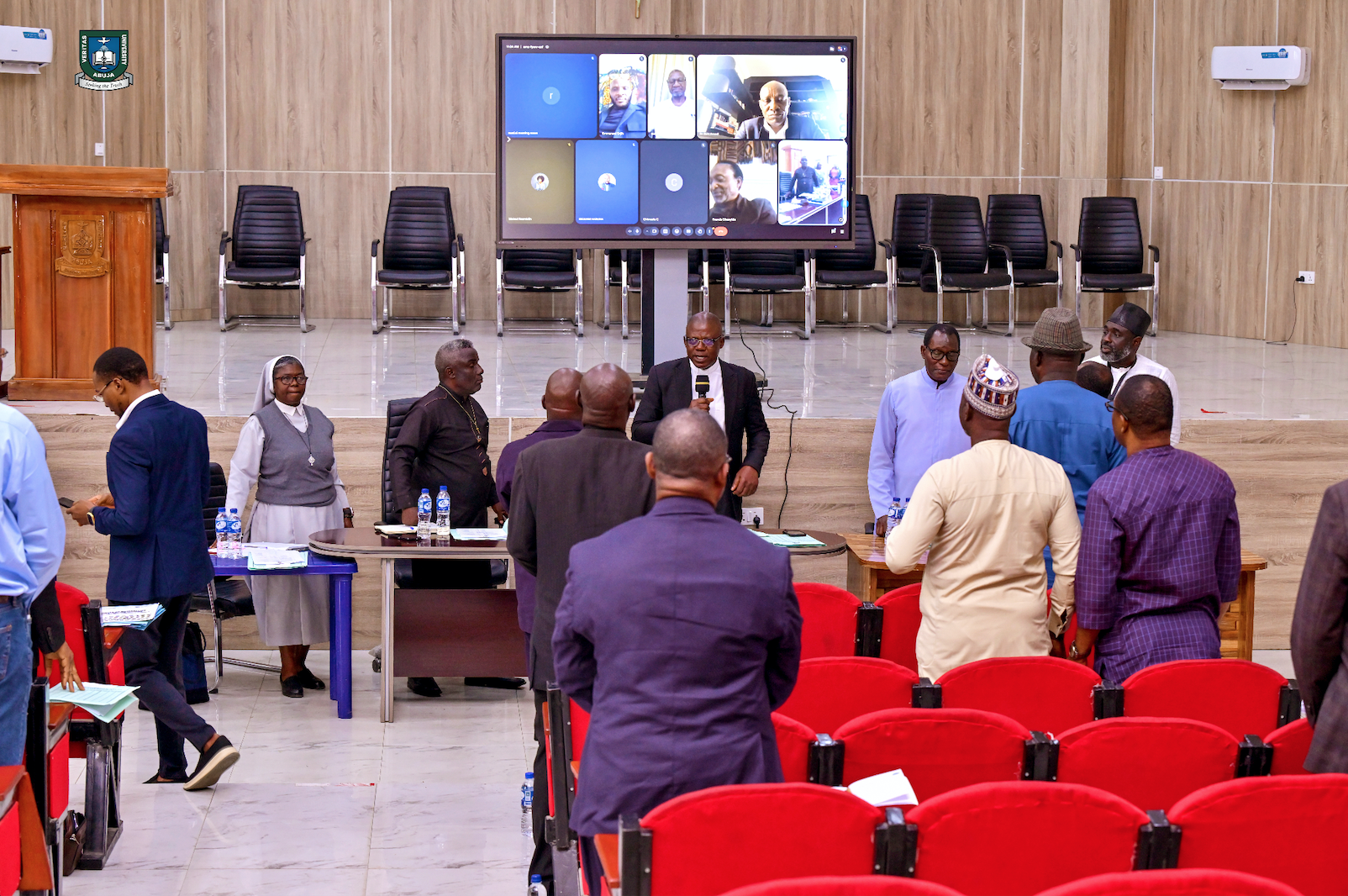
The signing took place on Thursday, 25 June 2026 — the one-month anniversary of the release of Magnifica Humanitas — in the Senate Chamber of Veritas University Abuja, before the 154th Senate of the University assembled.

The Vice-Chancellor, Rev. Fr. Prof. Hyacinth Ichoku, signed the Compact on behalf of Veritas University after briefly suspending the ordinary business of Senate for what he described as a solemn act of institutional witness.

"This Compact is our institutional response to that call, beginning from Africa, and extending globally to all institutions entrusted with the formation, protection, education, healing, governance, and advancement of the human person."

— Rev. Fr. Prof. Hyacinth Ichoku, Vice-Chancellor, Veritas University Abuja
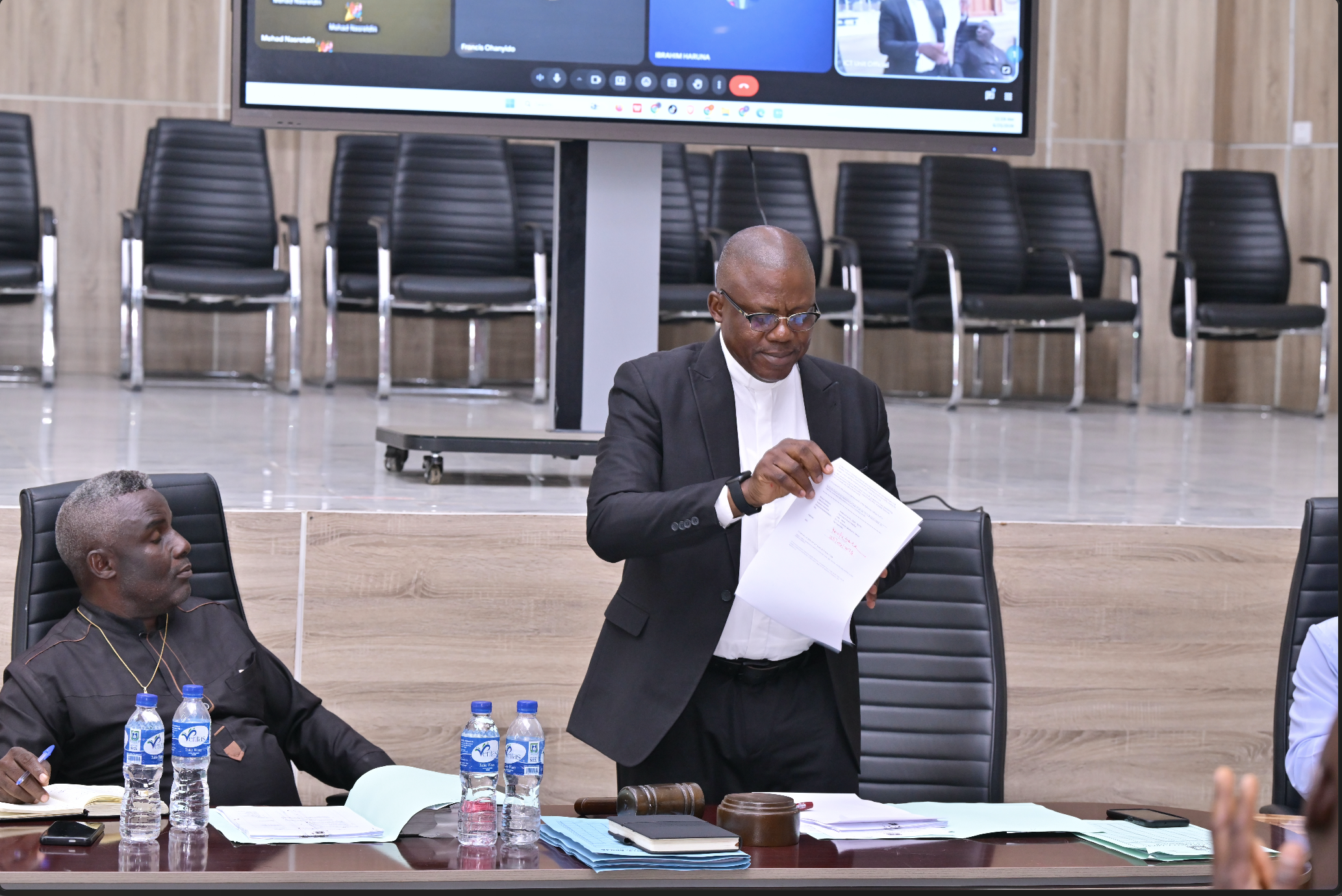
Rev. Fr. Prof. Hyacinth Ichoku after signing the Humanitas AI Compact at Veritas University
The Vice-Chancellor after signing on behalf of Veritas University Abuja

The Compact is directed first toward the poor, the sick, women and girls, young people, workers, communities affected by conflict, and all those vulnerable to exclusion, sickness, displacement, manipulation and invisibility.

The physical signing was witnessed and joined by institutions and leaders from education, public policy, health, technology, human development and African scholarship.

The full signing ceremony of the Humanitas AI Compact assembled in the Senate Chamber of Veritas University Abuja
The assembled signatories and witnesses in the Senate Chamber of Veritas University Abuja

The Signatories

Prof. Emeka Aniagolu, Chairman of the Steering Committee of Humanitas AI and a professor of African and African-American history and politics at Ohio Wesleyan University and Ohio State University for over 36 years, described the ceremony as the first physical witness to a wider institutional movement.

"This is not an ordinary signing. It is the first physical witness to an institutional commitment: that artificial intelligence must serve humanity."

— Prof. Emeka Aniagolu, Chairman, Steering Committee of Humanitas AI
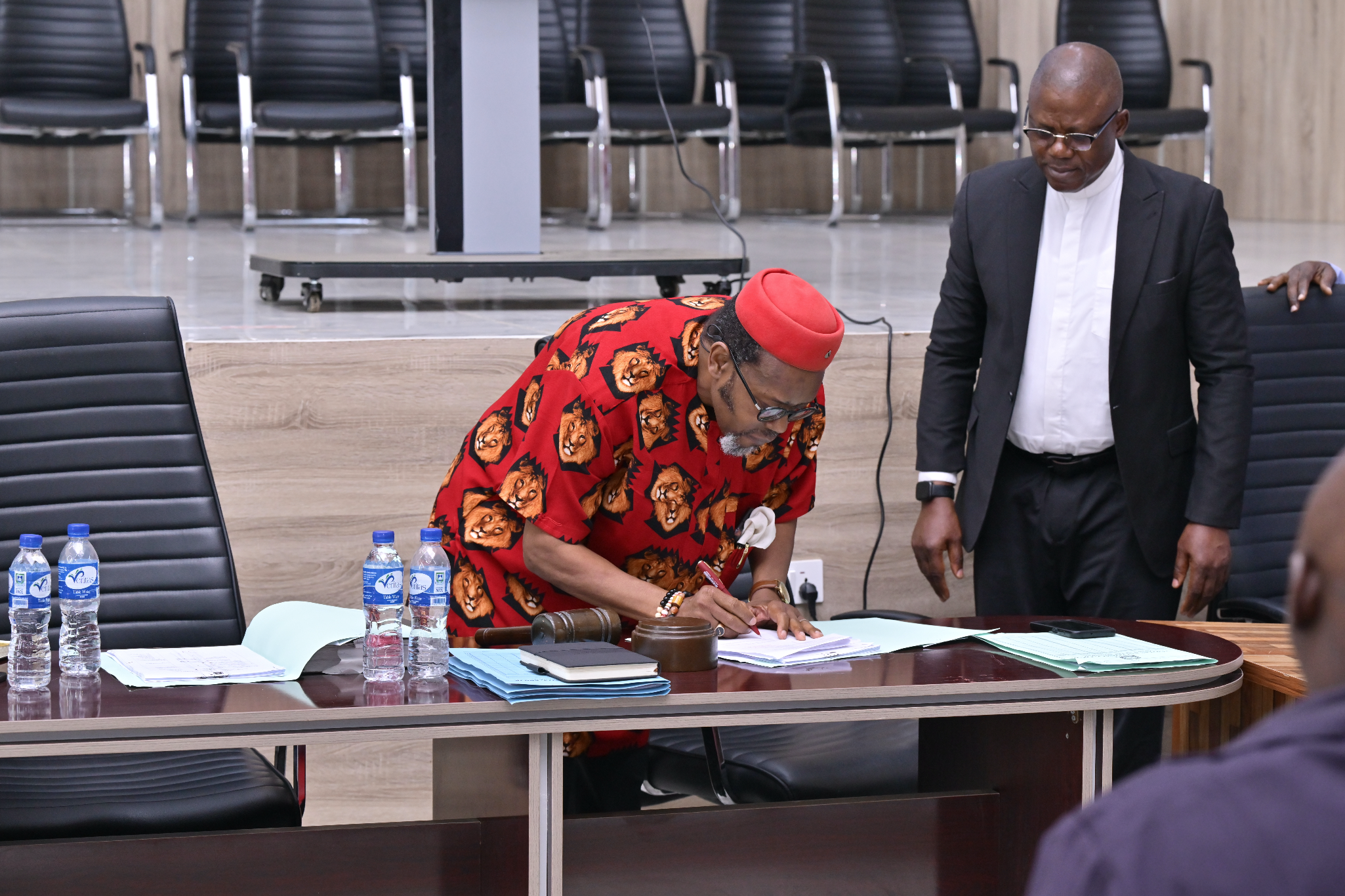
Prof. Emeka Aniagolu signing the Humanitas AI Compact on behalf of AIAAS
Prof. Emeka Aniagolu signing on behalf of the Africa Institute of African American Studies (AIAAS)

He said the first physical signing opens the way for a wider foundational signing of the Humanitas AI Compact, to be gathered electronically on the second month anniversary of Magnifica Humanitas.

Dr. Sam Amadi, Nigeria's former electricity regulator and Chairman of the Center for AI, Digital Justice and Economic Rights (CADER) — who holds an MPA, LL.M, and SJD from Harvard — signed on behalf of CADER, whose stated goal is ensuring that artificial intelligence reduces inequality.

Dr. Mehad Nasreldin, Sudanese public-health physician and digital-health advocate, signed on behalf of the African Institute of Public Health (AIPH), bringing a wider African public-health presence to the first physical witness.

Elder Appiah-Wilson, a Ghanaian-born member of the Board of Governors of Commonwealth Forum and a veteran senior security, intelligence, and immigration officer of the British Government, signed on behalf of Commonwealth Forum, bringing its development mandate and deep experience in protection, mobility, and conflict-affected communities.

Rev. Fr. Prof. Hyacinth Ichoku, Vice-Chancellor of Veritas University Abuja, in the act of signing the Humanitas AI Compact
The act of signing — Rev. Fr. Prof. Hyacinth Ichoku commits Veritas University to the Humanitas AI Compact Photo: Shekolo Danjuma · Official Photographer / Videographer, Veritas University

A Tradition in Motion

The signing places Magnifica Humanitas within a Catholic tradition in which papal encyclicals are taken out of paper and given institutional life. When Pope Leo XIII issued Rerum Novarum in 1891, priests, workers, bishops and Catholic institutions moved — organizing around workers' dignity, fair wages, cooperatives, credit institutions, and social action. In Spain, Fr. José María Arizmendiarrieta helped turn that tradition into Mondragon, one of the world's most important cooperative movements.

Now Pope Leo XIV has spoken to the age of artificial intelligence through Magnifica Humanitas. In Africa — the continent most exposed to poverty, weak health systems, conflict, exclusion and the vulnerability of women and girls — Rev. Fr. Prof. Hyacinth Ichoku is leading the first physical signing of the Humanitas AI Compact at Veritas University.

The Seven Principles & Seven Commitments

The Humanitas AI Compact rests on seven principles drawn from the tradition of Catholic social teaching and the direct teaching of Magnifica Humanitas: Human Dignity, Solidarity, Subsidiarity, The Common Good, The Universal Destination of Goods, Truth, and The Integral Person.

Two commitments shape the first practical phase. Commitment II commits to equipping students, staff and those served with genuine digital literacy. Commitment V commits to forming a renewed educational alliance for the digital age, with families, communities and institutions across the world, placing the human person and the common good at the centre of all they do.

These commitments will translate into practical pathways for foundational signatories: free introductory AI training for teachers; AI literacy and international university engagement for students; AI readiness diagnostics and model AI policy support for schools; and applied AI, recognition, certification and work-readiness pathways for artisans, technicians, traders and working learners.

A Global Response Beginning from Africa

Emmanuel Orjih, Director of Humanitas AI — a Wharton MBA and former World Bank and U.S. Government professional with 30 years' experience across 28 countries — noted that the Catholic education network includes over 231,000 schools and universities serving more than 71 million students worldwide, with four in ten Catholic-school students in Africa.

"The AI age requires two abilities: the ability to marshal AI, and the ability to do what AI cannot do. The people who already do what AI cannot do must not be left outside the AI age."

— Emmanuel Orjih, Director of Humanitas AI

Africa has crossed 1.5 billion people and is projected to move toward 2.5 billion by 2050, with Sub-Saharan Africa holding the world's youngest population — about 70 percent under 30. In an age when AI is changing work and creating new forms of productive ability, Africa's young people must be prepared not only to use AI, but to do the work AI cannot do.

The Humanitas AI Compact is not an African project only. It is a global response beginning from Africa, with Latin America and Asia playing anchor roles. Brazil and the Philippines — with their deep Catholic educational and institutional presence — point to the worldwide breadth of the response now being invited.

What Comes Next

The next phase will invite institutions across the Global South to enter the foundational signing electronically through humanitasAI.org. After the foundational signing, each monthly anniversary of Magnifica Humanitas will be used to report progress, announce new signatories, and present advances in training, partnerships, research and implementation.

Sign the Compact